










Table of Contents
ToggleSoccer Jersey vs Football Jersey: What’s the Difference?
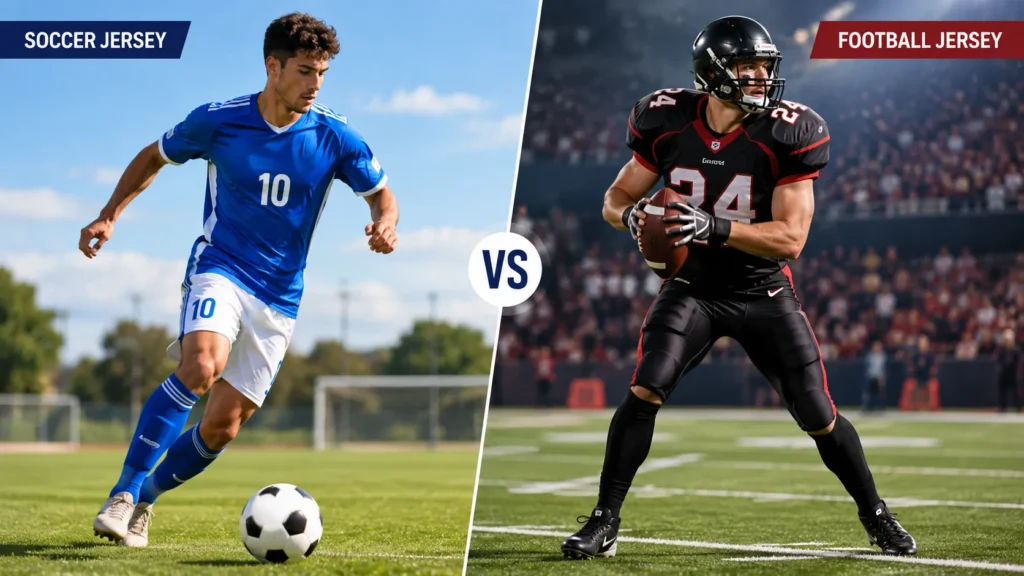
Soccer jerseys and American football jerseys may serve a similar fundamental purpose, identifying players on a field and fostering team unity—but they are highly specialized garments designed for entirely different athletic demands.
Choosing the right uniform for a school, club, league, or competitive team goes far beyond simply picking out appealing colors and a sharp logo. The correct jersey fundamentally affects player comfort, mobility, body temperature regulation, and how well the uniform integrates with the sport’s unique physical requirements.
In this comprehensive educational guide, we will explore the difference between soccer and football jerseys, breaking down construction, materials, fit, protective equipment compatibility, and long-term maintenance. Whether you are outfitting a youth academy or upgrading a varsity athletic program, understanding these distinctions will help you navigate your athletic team jersey options and make an informed, confident decision for your roster.
What’s the Difference Between Soccer and Football Jerseys?
The primary difference between a soccer jersey and an American football jersey is their structural design, which is dictated by the sport’s equipment and movement needs.
Soccer jerseys are engineered to be lightweight, streamlined, and highly breathable to support 90 minutes of continuous running and natural body movement without restriction. American football jerseys are constructed with heavier, structurally reinforced fabrics and are cut significantly wider in the shoulders and chest to securely accommodate bulky, hard-shell protective pads while withstanding the extreme high-impact forces of tackling and blocking.
Feature Comparison
Feature | Soccer Jersey | American Football Jersey |
Primary Goal | Continuous mobility, aerodynamics, and breathability | Unyielding durability and protective equipment compatibility |
Fit & Silhouette | Streamlined, athletic, natural body contour | Roomier, highly structured, broad-shoulder fit |
Sleeve Style | Standard short (raglan) or standard long sleeves | Shorter, elasticized, or capped sleeves to grip pads |
Fabric Weight | Extremely lightweight, highly ventilated | Heavy-denier, highly durable, stretch-woven performance fabric |
Protective Gear | None worn under the upper body (base layer optional) | Specifically tailored to stretch over hard-shell shoulder pads |
Numbering | Large on the back; optional on front/shorts | Extremely large, prominent on both the front and back |
Physical Demands | Running, sprinting, rapid changes of direction | Tackling, blocking, grappling, and short bursts of impact |
Key Differences Between Soccer and Football Jerseys
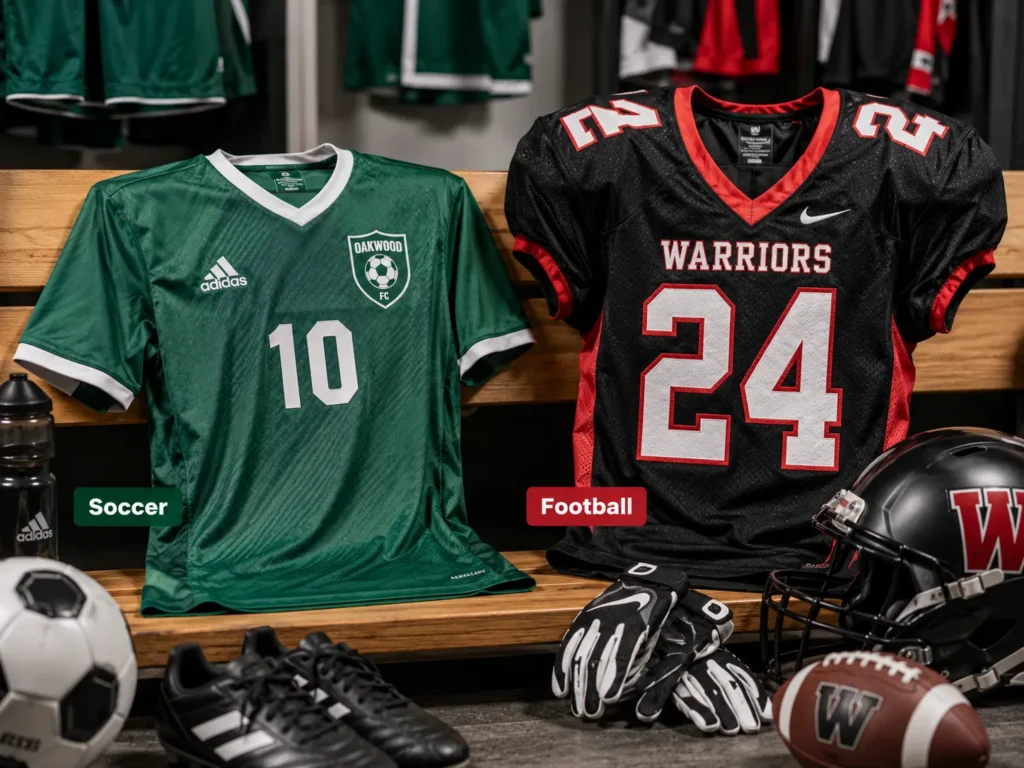
When comparing soccer and American football uniforms, many of the differences come down to how each sport is played. Below are the most common questions buyers, coaches, and players ask when choosing between the two.
What is the main difference between soccer and football jerseys?
The biggest difference is design and purpose. Soccer jerseys are lightweight, slim-fitting, and made to maximize speed, comfort, and breathability during continuous movement. Football jerseys are heavier, more durable, and designed to fit over protective shoulder pads while withstanding frequent physical contact.
Why are football jerseys heavier?
Football jerseys use thicker fabrics and reinforced stitching because they must handle tackling, blocking, and constant physical contact. Soccer jerseys prioritize lightweight performance, making them significantly lighter and more breathable.
Which sport requires more protective equipment?
American football requires extensive protective gear, including shoulder pads and additional body protection worn underneath the jersey. Soccer players generally wear only shin guards beneath their socks, allowing jerseys to remain lightweight and close-fitting.
Can a soccer jersey be used for football?
Generally, no. Soccer jerseys are not designed to fit over football pads and lack the durability needed for the physical demands of American football.
Which jersey offers better breathability?
Soccer jerseys provide superior breathability because they are designed for continuous running. Moisture-wicking fabrics and ventilation panels help keep players cool throughout the match.
Why do the uniforms look so different?
The appearance reflects the requirements of each sport:
- Soccer jerseys: Lightweight, streamlined, and designed for unrestricted movement.
- Football jerseys: Wider shoulders, reinforced construction, and extra room to accommodate protective equipment.
Which jersey is easier to customize?
Both jersey styles support customization, but each is optimized differently:
- Soccer jerseys are ideal for detailed graphics, sponsor logos, club crests, and modern designs.
- Football jerseys prioritize large player numbers, bold lettering, and high visibility during games.
Key Differences in Construction and Performance
While the quick answers provide a broad overview, equipment managers and team buyers need a deeper understanding of how these garments are engineered from the thread up.
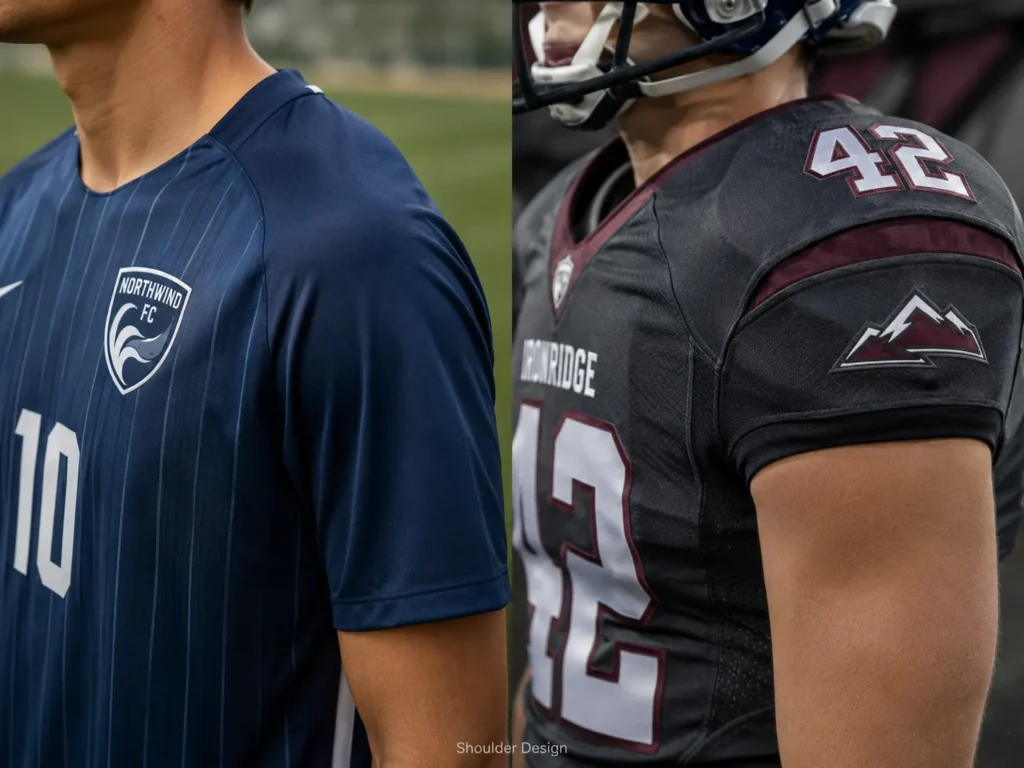
1. Silhouette, Fit, and Overall Shape
Soccer jerseys utilize a sleek, anatomical shape. Because there is no upper-body armor to account for, the fabric is meant to fall naturally against the human torso. This athletic fit is crucial; excess baggy material creates aerodynamic drag and can easily get tangled or grabbed by an opponent. The cut allows a player’s arms to move freely for running mechanics, balance, and taking throw-ins.
American football jerseys utilize an “equipment-ready” cut. If you take a football game jersey and lay it flat on a table, it looks disproportionately wide at the top. The chest, shoulders, and armholes are intentionally oversized to securely wrap around bulky padding. Conversely, the waist is often tapered or fitted with a highly elastic hem so it remains tucked tightly into the pants, giving opposing linemen less fabric to grab onto.
2. Shoulder and Sleeve Architecture
The shoulder area is the most immediate visual identifier between the two sports, reflecting completely different engineering requirements.
- Soccer: Follows the natural slope of the human shoulder. They frequently utilize a “raglan” sleeve design (where the sleeve fabric extends in one piece fully to the collar), which eliminates the shoulder seam entirely to prevent chafing during continuous arm pumping. Sleeves usually end mid-bicep and hang loosely for maximum airflow.
- Football: Features specialized, highly complex “yoke” construction across the top. The shoulders are heavily reinforced with multiple layers of fabric. The sleeves are typically shortened—often terminating right at the shoulder line or upper bicep—and finished with tight elastic cuffs. This functional design keeps the sleeve pulled taught against the pad, making it incredibly difficult for opponents to gain a holding advantage.
3. Fabric Engineering and Material Science
Modern performance uniforms rely heavily on synthetic materials like polyester, but the way the yarn is woven and treated differs wildly.
If you are sourcing performance athletic apparel for a team, you will notice that soccer gear uses micro-polyester blends focused purely on capillary action. This means the microscopic structure of the fabric is designed to pull sweat away from the skin and disperse it across the surface of the shirt where it can evaporate instantly.
Football jerseys, on the other hand, incorporate a high percentage of spandex or elastane woven into heavy-denier (thicker yarn) polyester. This creates a durable “four-way stretch.” The heavy fabric must be able to expand tightly over rigid plastic pads, absorb a high-velocity impact, and immediately snap back into its original shape without permanently stretching out or losing its structural integrity.
4. Player Identification and Numbering Rules
The placement and sizing of numbers and names are strictly regulated by the respective sports’ governing bodies.
- Soccer: Focuses heavily on a single large number on the back of the shirt. The front of the jersey is traditionally reserved for a team crest and a prominent primary sponsor graphic. Front numbers (if used at all) are typically small (around 4 inches) and placed on the chest or on the front of the shorts.
- Football: Prioritizes absolute utility, rapid identification, and visibility. Huge numbers (often 10 inches on the front, 12 inches on the back) dominate the torso. Furthermore, “TV numbers” are frequently placed on the top of the shoulders or the side of the upper sleeves so spotters, coaches, and referees can identify players from a side profile or from above in a crowded pile-up.
Cost and Budgeting—Planning Your Uniform Investment
Understanding the physical differences is only half the battle; team buyers must also understand how these differences impact the organization’s budget. Outfitting a team for either sport represents a significant financial investment, but the pricing structures differ.
Budgeting for Football Uniforms
Because American football jerseys require thicker materials, complex paneled stitching, stretch zones, and reinforced yokes, the cost per individual garment is generally higher. Furthermore, custom tackle twill (sewn-on numbers and letters) is popular in football for durability, which increases production costs compared to printed jerseys. However, football teams typically only need two jerseys per player (a dark home jersey and a white away jersey) that will last for multiple strenuous seasons if cared for properly.
Budgeting for Soccer Uniforms
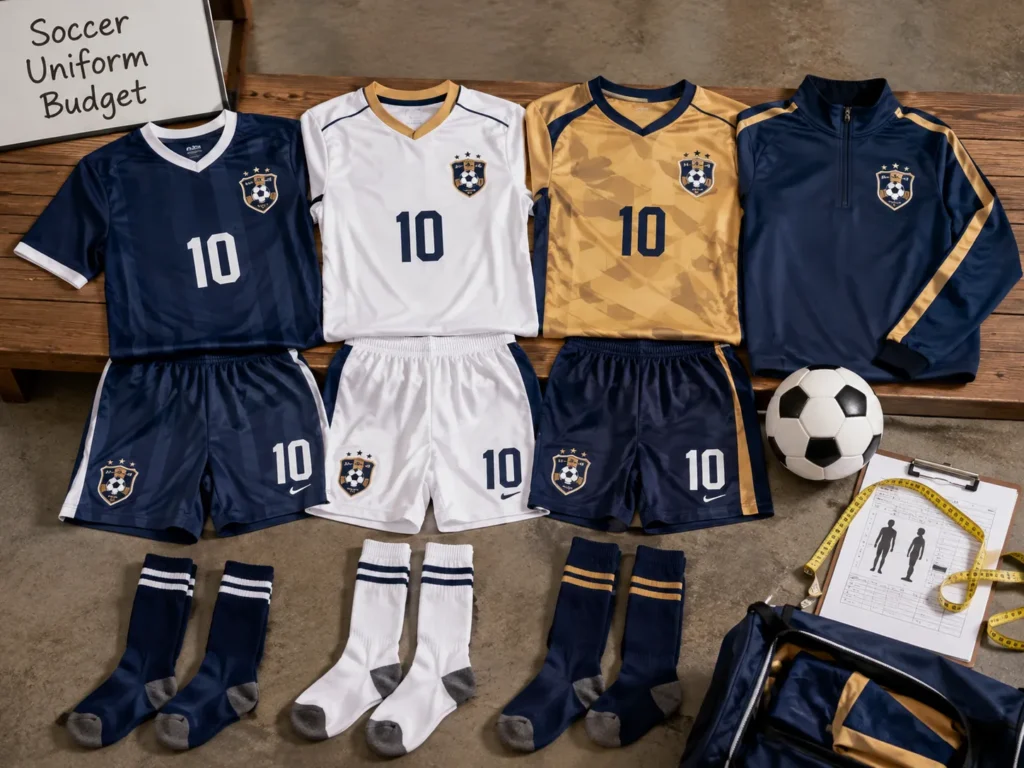
While an individual soccer jersey is generally less expensive to manufacture due to lighter materials and simplified construction, soccer teams often require a larger quantity of gear. A standard competitive soccer player often needs a home kit, an away kit, a specialized alternate/third kit to avoid color clashes, and distinct training/warm-up jerseys. Therefore, the overall apparel budget per player can equalize quickly.
To ensure you stay within your organization’s budget, always check our youth sports uniform sizing guide to avoid ordering incorrect sizes, which leads to costly mid-season reorders.
Lorem ipsum dolor sit amet, consectetur adipiscing elit. Ut elit tellus, luctus nec ullamcorper mattis, pulvinar dapibus leo.
Care and Maintenance—Washing and Preserving Different Jerseys
The distinct fabrics used in these two sports require completely different laundering strategies to maintain their performance features and visual appeal.
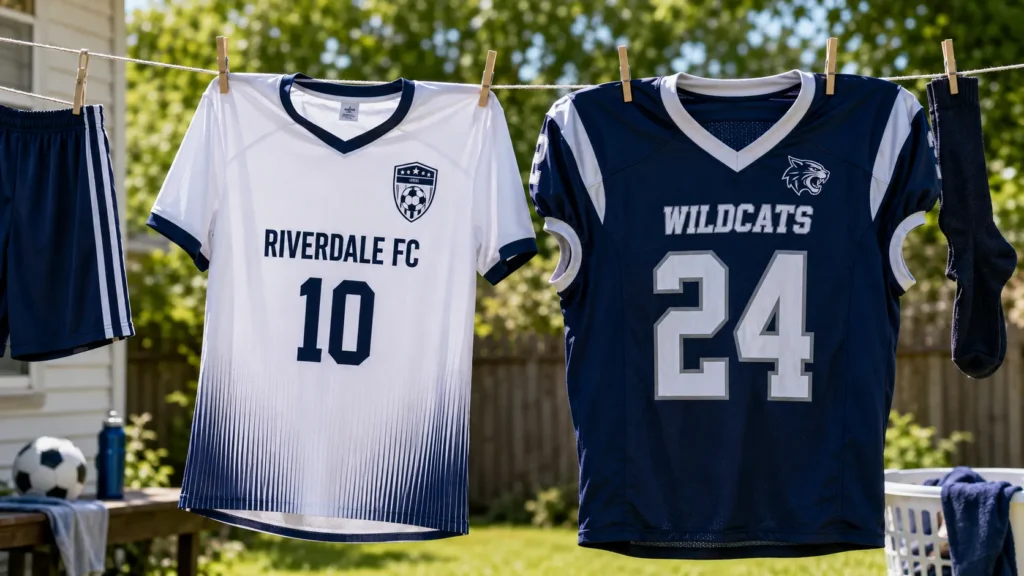
Caring for Soccer Jerseys
The primary enemy of a soccer jersey is odor retention and the degradation of its moisture-wicking properties.
- Wash inside out: This protects delicate printed sponsor logos, crests, and numbers from peeling or cracking against the washing machine drum.
- Cold water only: Hot water can break down the micro-fibers and cause synthetic materials to shrink or warp.
- NO Fabric Softener: This is critical. Fabric softeners coat the fabric in a waxy residue that completely destroys the capillary action of moisture-wicking clothing, trapping sweat and heat against the player’s body.
- Air Dry: Hang the jerseys to dry. The lightweight fabric will dry very quickly. Machine drying, even on low heat, accelerates the deterioration of custom printing and elastane threads.
Caring for American Football Jerseys
Football jerseys face extreme physical abuse, including deeply ground-in mud, grass stains, and occasionally blood.
- Pre-soak: Heavy grass and mud stains on thick football mesh require a pre-soak in cold water with an oxygen-based stain remover. Avoid harsh bleaches, which weaken the spandex fibers necessary for the jersey to stretch over pads.
- Heavy Duty, but Cold: Use a heavy-duty cycle for heavily soiled jerseys, but maintain a cold or lukewarm water temperature. Hot water will bake mud stains permanently into the thick polyester fibers.
- Check the Twill: If the jersey features sewn-on tackle twill numbers, inspect the edges periodically for fraying.
- Air Dry when possible: While heavy football jerseys take longer to air dry than soccer kits, tumble drying on high heat will melt the elastic cuffs and warp the structural integrity of the shoulder yoke.
Practical Recommendations for Team Buyers
If you are tasked with buying uniforms, your priorities will shift depending on your specific role and organization. Use these practical guidelines to ensure you make the best purchasing decision.
For Coaches and Equipment Managers
Your primary focus must be on longevity and strict compliance with league rules.
- Football: Ensure the garments you order specifically complement the brand and physical size of the shoulder pads your school uses. Refer strictly to NCAA Football Rules or your state’s high school athletic association guidelines regarding exact number dimensions, placement, and color contrast rules.
- Soccer: Prioritize seam strength under the arms (a common failure point) and the quality of the moisture-wicking technology. Ensure the kits comply with the IFAB Laws of the Game, particularly regarding mandatory equipment and the rule that undergarments (like compression shirts) must match the main color of the jersey sleeve.
For Schools and Youth Organizations
When buying for youth programs, durability and accurate sizing are paramount. Kids grow rapidly, and predicting youth equipment dimensions can be tricky.
- Do not order football uniforms based on a child’s standard t-shirt size. Always measure the athlete while they are actively wearing their shoulder pads.
- For youth soccer, ultra-lightweight elite-level match shirts (the kind professionals wear) are often too fragile for kids who are rough on their gear. Opt for a mid-weight, highly durable training fabric that balances breathability with playground resilience.
For Recreational Leagues and Intramurals (Flag & 7-on-7)
If your league plays flag football or 7-on-7 touch football, you do not need a traditional padded football game jersey.
- Because there are no shoulder pads in flag football, a heavy-duty traditional football cut will fit awkwardly, sagging heavily off the natural shoulders and hindering the player’s movement.
- Instead, many flag football leagues opt for compression shirts, sleeveless performance tops, or adapted soccer-style athletic fits that provide a natural silhouette without the unnecessary, heavy bulk.
How to Approach Uniform Customization
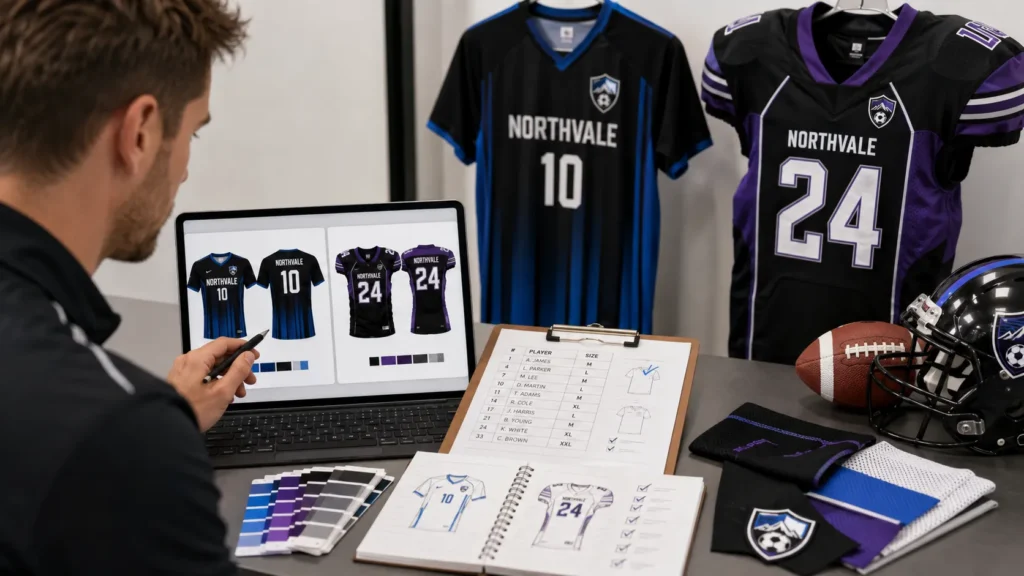
Customizing team gear requires careful planning. Whether you are using screen printing, heat press, sublimation, or traditional tackle twill, the decoration method should be guided by the sport you are playing.
- Match the Method to the Fabric:
Sublimation (a process where specialized ink is heated and baked directly into the fabric’s fibers) is exceptionally popular for soccer. It leaves no heavy, rubbery feel on the shirt, keeping the garment 100% lightweight and breathable. For football, sewn-on tackle twill or heavy-duty vinyl heat transfers are often preferred because they offer the sheer durability required to survive a season of tackling. Exploring different customization techniques for team gear will help you find the perfect balance of weight, cost, and longevity. - Standardize Team Branding:
Confirm exact Pantone colors, standardized fonts, and specific logo placements. A uniform program looks disjointed and unprofessional if the youth academy features a slightly different shade of blue than the varsity squad. - Double-Check Roster Data:
Always create a master spreadsheet containing player names (check spelling twice!), assigned numbers, and verified sizes. - Demand a Digital Mock-Up:
Never approve a bulk apparel order without seeing a digital proof first. This allows you to verify that the sponsor logo doesn’t awkwardly overlap the chest numbers, and that the team colors will render correctly on the chosen fabric texture.
Final Verdict
When evaluating a soccer jersey vs football jersey, the decision is dictated entirely by the physical realities and rules of the respective sports.
Soccer jerseys are marvels of lightweight textile engineering, built for speed, exceptional breathability, and unrestricted natural movement on a massive pitch. Conversely, American football jerseys are heavy-duty, highly structured garments specifically tailored to stretch dynamically over bulky protective armor and survive the intense, repeated physical trauma of the gridiron.
Understanding these foundational structural differences ensures that your players stay comfortable, perform at their absolute peak, and step onto the field looking unified and professional.
Ready to bring your team’s visual identity to life? Whether you are outfitting a fast-paced soccer club or a hard-hitting elite football program, we have the specialized apparel and deep industry knowledge to meet your needs. Request a free digital mock-up or custom quote today, and let our expert design team help you build the perfect uniform program for your upcoming season.

Frequently Asked Questions (FAQ)
Is a soccer jersey the same as a football jersey?
No, if by “football” you mean American gridiron football. They are entirely different garments. Soccer shirts are thin, breathable, and tailored to the natural human body; American football uniforms are thick, highly durable, and cut excessively wide to fit over rigid protective padding.
Why do Americans call soccer and football jerseys different things?
In the United States, “soccer” refers to association football, while “football” refers to American gridiron football. In almost every other part of the globe, the word “football” means soccer. This linguistic difference heavily influences athletic apparel terminology depending on your geographic region.
Do football jerseys fit bigger than soccer jerseys?
Yes, but they fit differently, not just larger. A football cut has exaggerated width and volume in the chest and shoulders to house protective pads, while the waist remains relatively standard or tapered. You cannot directly compare a size Large soccer kit to a size Large game-cut football uniform.
Can I wear an American football jersey for casual everyday wear?
Yes, many fans wear replica tops casually. However, note that “game-cut” or “authentic” versions are explicitly tailored for pads and will look incredibly wide, stiff, and droopy on natural shoulders. Fans usually prefer “replica” or “fan-cut” versions, which are modified to fit more like a standard t-shirt while maintaining the aesthetic of the sport.
What is the best material for athletic jerseys?
For modern high-performance sports, synthetic polyester is the undisputed industry standard due to its durability, moisture-wicking capabilities, and vibrant dye retention. Soccer utilizes micro-mesh polyester for extreme lightness, while football uses heavy-denier polyester blended with spandex/elastane for elasticity and brute strength.