



Table of Contents
ToggleThe Ultimate Pickleball Paddle Guide
Introduction
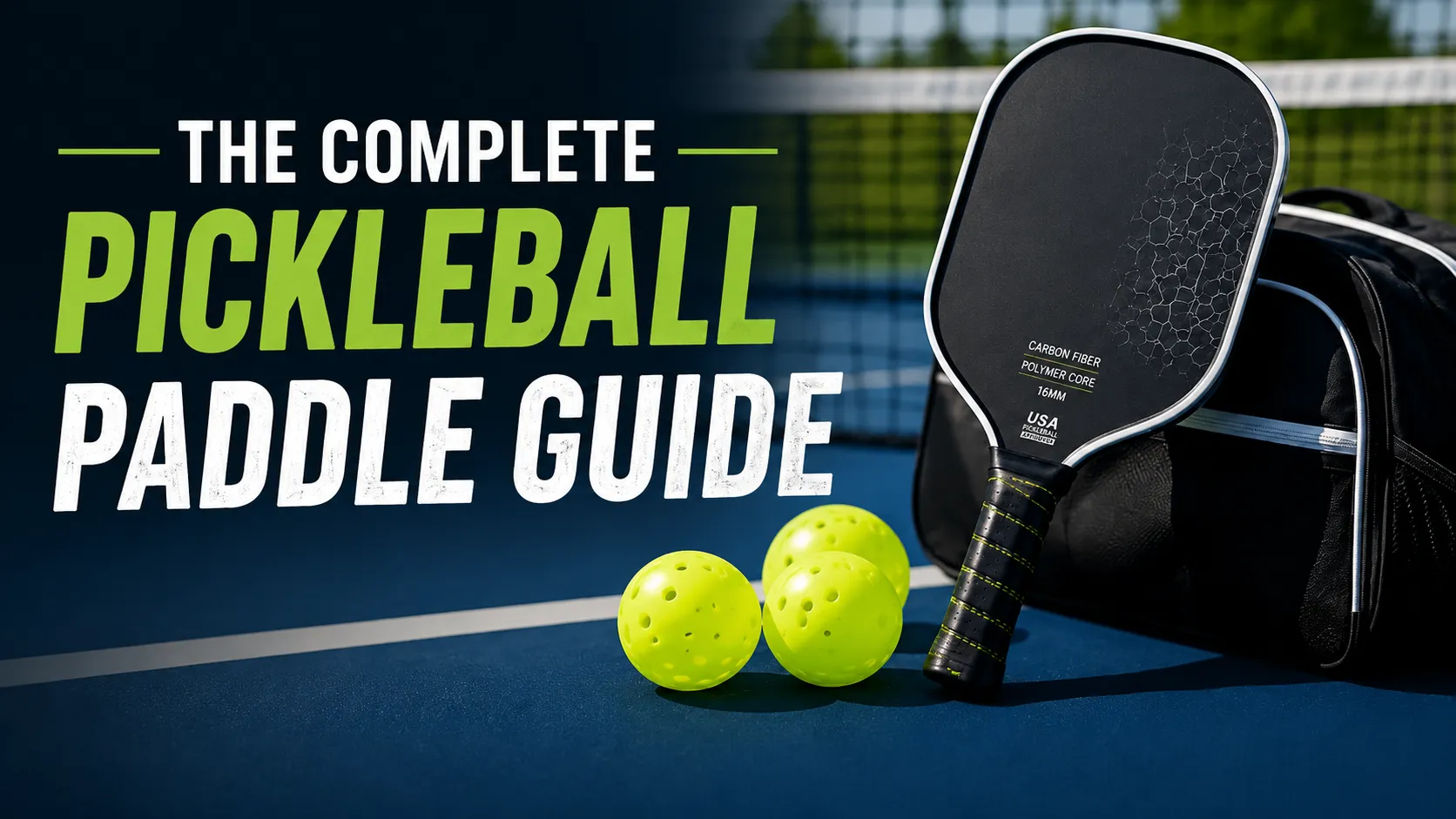
Choosing the right pickleball paddle can have a bigger impact on your game than many beginners expect. The paddle affects your power, control, spin, comfort, and overall playing experience.
However, with so many options available, choosing the right paddle can be confusing. Paddle materials, core construction, weight, grip size, and maintenance all influence how a paddle performs.
Whether you are buying your first pickleball paddle, upgrading your equipment, or looking for custom pickleball paddles for a team, club, or event, this complete guide covers everything you need to know.
Is Paddle Tennis the Same as Pickleball?
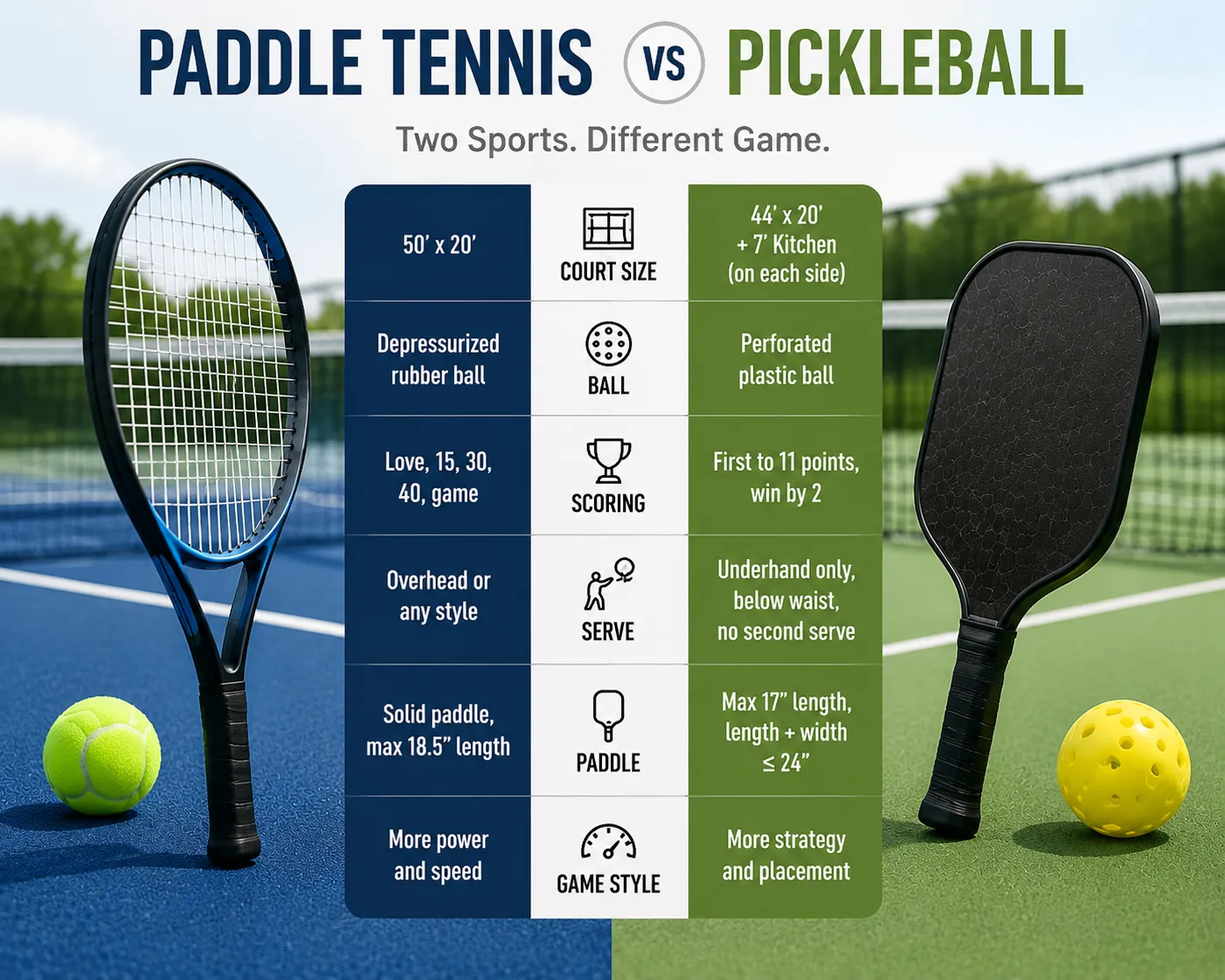
No. Both sports use paddles and share a net across a smaller court than traditional tennis, they differ in court dimensions, ball type, scoring, and rules in ways that make each sport its own game.
Court size
A paddle tennis court is 50 feet long and 20 feet wide. A pickleball court is 44 feet long and 20 feet wide, with a no-volley zone known as the kitchen that extends 7 feet from the net on each side. There’s no equivalent zone in paddle tennis.
The ball
Paddle tennis uses a depressurized rubber ball similar to a tennis ball but with lower pressure, which makes it bounce lower and move more slowly. Pickleball uses a lightweight perforated plastic ball with holes, similar to a Wiffle ball. The hole pattern differs between indoor and outdoor versions.
Scoring
Paddle tennis follows traditional tennis scoring: love, 15, 30, 40, game. Pickleball uses a simpler system where games go to 11 points, the winning team must lead by 2, and only the serving team can score a point during any given rally.
Serving
Paddle tennis allows overhead or any style of serve. Pickleball requires an underhand serve, contact below the waist, and no second serve attempt. One nuance: in paddle tennis, a serve that clips the net and lands in play can be replayed. In pickleball, that same play simply continues.
The paddles
Paddle tennis paddles are solid and stringless, typically made from carbon fiber or fiberglass, with a maximum length of 18.5 inches. Pickleball paddles must be under 17 inches in length with the combined length and width not exceeding 24 inches. The feel between them is different: pickleball paddles feel lighter and more responsive, while paddle tennis paddles deliver a firmer, more tennis-like hit.
Which One Is Better for Beginners?
For many new players, pickleball is easier to start because the court is smaller and the game relies more on strategy and positioning than physical power.
What Makes a Good Pickleball Paddle?
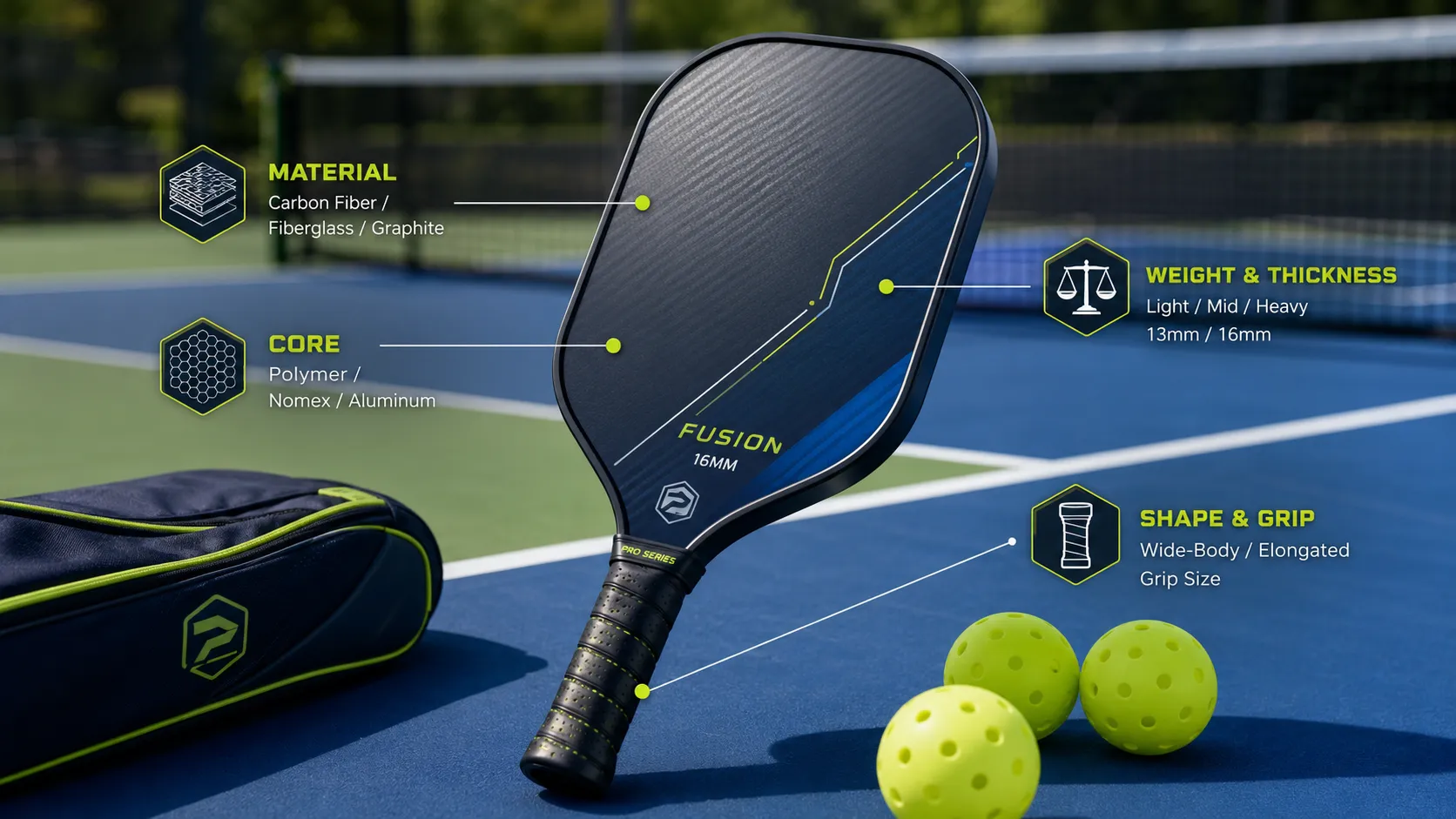
A good pickleball paddle is not simply the most expensive option. The best paddle is one that provides the right balance of power, control, spin, and comfort based on your playing style, skill level, and personal preference.
Several factors influence paddle performance, including the surface material, core construction, thickness, weight, paddle shape, and grip size. The paddle face affects spin and ball response, while the core controls energy absorption, power, sweet spot size, and overall feel.
Paddle Material
The paddle surface material plays an important role in how the ball feels on contact, affecting spin, control, and power.
Carbon Fiber Pickleball Paddle
Carbon fiber paddles are popular among intermediate and advanced players because they provide excellent control, consistency, and spin.
Raw carbon fiber surfaces create a textured feel that helps the ball grip the paddle face longer, allowing players to generate more reliable spin. Compared with traditional coated surfaces, raw carbon fiber textures can maintain their performance more consistently over time.
Fiberglass Pickleball Paddle
Fiberglass surfaces are more flexible than carbon fiber, creating additional energy transfer when hitting the ball. This flexibility helps generate more power and a stronger hitting feel, although it may provide slightly less control compared with carbon fiber paddles.
Fiberglass paddles are often a good choice for players who want easier power and a more responsive feel.
Graphite Pickleball Paddle
Graphite paddles are lightweight, stiff, and highly responsive. They are suitable for players who value quick reactions, precision, and better control during fast exchanges.
Paddle Core
The paddle core is one of the most important factors affecting power, control, sound, and overall feel.
Polymer Honeycomb Core
Polymer (polypropylene) honeycomb cores are the most common choice in modern pickleball paddles.
The soft plastic structure absorbs impact effectively, creating a quieter feel, better control, and a larger sweet spot. This makes polymer cores suitable for players who want a comfortable and consistent playing experience.
Nomex Core
Nomex cores are made from a harder aramid material and provide a firmer, more powerful response.
However, they produce a louder hitting sound and generally offer less forgiveness compared with polymer cores, making them less common in newer high-end paddles.
Aluminum Core
Aluminum cores are lightweight and provide excellent touch and control. However, they absorb more energy during impact, which means they usually generate less power compared with polymer or Nomex cores.
Paddle Weight and Thickness
Most pickleball paddles weigh between 7.0 and 8.5 ounces. Paddle weight affects swing speed, stability, and power.
- Lightweight paddles (7.0–7.5 oz):Provide faster reaction speed, easier maneuverability, and are ideal for players who prefer quick hand exchanges and control.
- Midweight paddles (7.5–8.3 oz):Offer the best balance of power, stability, and maneuverability, making them a popular choice for most players.
- Heavy paddles (8.3+ oz):Provide more power and stability but require more strength and can feel slower during fast rallies.
Core thickness also affects paddle performance. Thicker paddles (around 16mm) usually provide better control, stability, and a larger sweet spot, while thinner paddles (around 13mm) offer a faster response and more power.
Paddle Shape and Grip Size
Paddle shape affects reach, sweet spot size, and overall playing style.
Wide-body paddles provide a larger sweet spot and more forgiveness, making them beginner-friendly and easier to control.
Elongated paddles offer additional reach and leverage, helping players cover more court area and generate more power.
Grip size also plays an important role in comfort, control, and spin. Smaller grips allow more wrist movement and can help players generate spin, while larger grips provide more stability and support.
Choosing the correct grip size can reduce hand fatigue and improve comfort during longer matches.
How to Hold a Pickleball Paddle
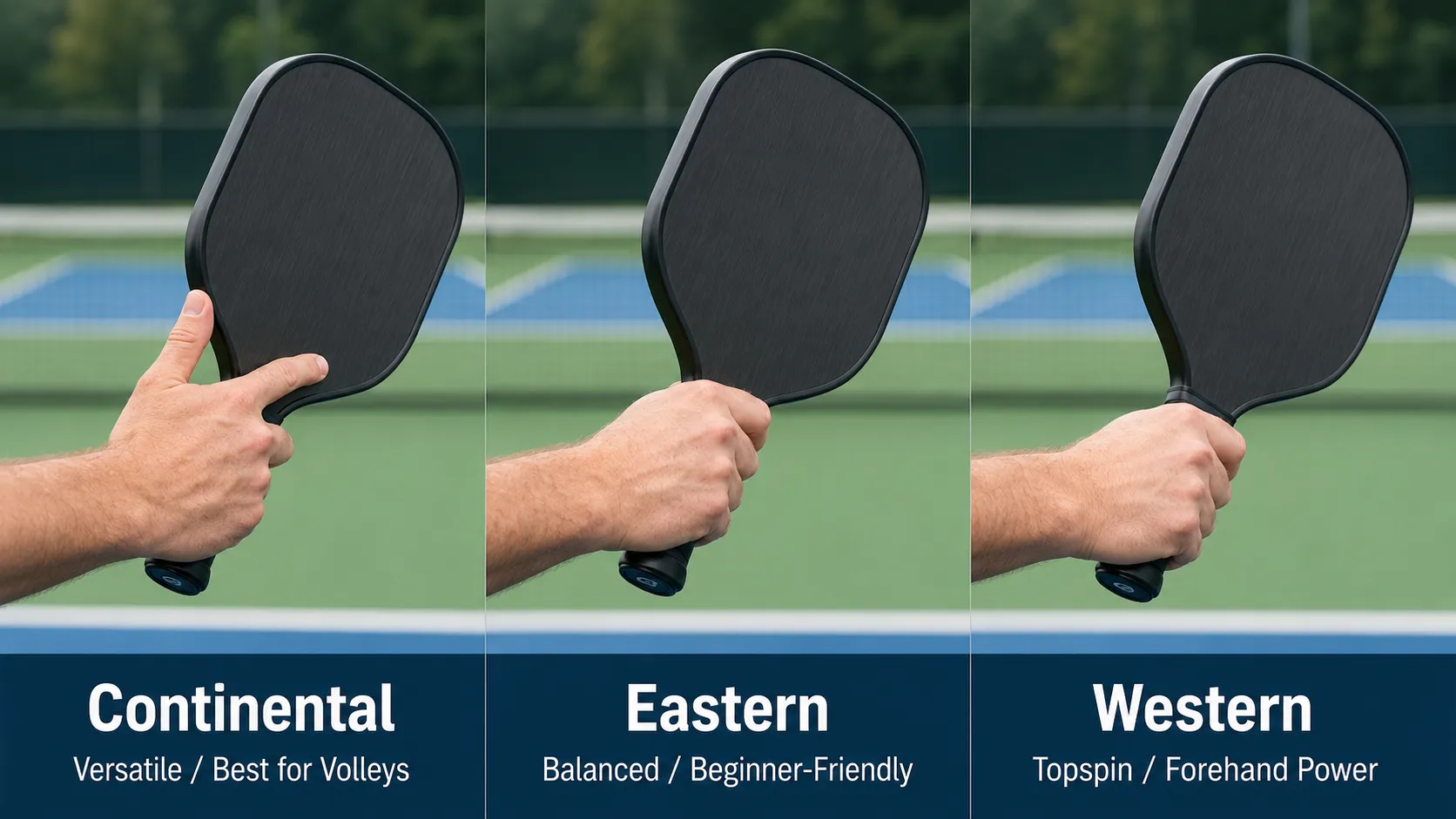
Your grip affects everything: spin, control, power, and how quickly you can switch from forehand to backhand. The Professional Pickleball Association (PPA) Tour notes three main grip types.
Continental grip (the hammer grip): Place the knuckle of your index finger on the second bevel of the paddle handle, forming a V between thumb and forefinger that sits on top of the handle. Think of holding a hammer. Most pros use this grip because it lets you switch between forehand and backhand without repositioning your hand. It’s also the best choice at the kitchen line where quick reactions matter most.
Eastern grip (the handshake grip): Slide the knuckle of your index finger to the third bevel. Pickleheads describes this as the most neutral of the three: it handles forehands and backhands comfortably and aligns naturally with the hand. Many beginners start here.
Western grip: Rotate 90 degrees clockwise from the Eastern grip position for right-handed players. This opens up heavy topspin on forehands and groundstrokes but limits backhand flexibility. This is why you’ll see players who use it hit backhands two-handed or switch grips mid-rally.
How to Regrip a Pickleball Paddle
A worn or slippery grip can affect your control and comfort during play. Most players should consider regripping their pickleball paddle after 50–100 hours of play, or whenever the grip loses tackiness, feels uncomfortable, or shows visible wear.
There are two common grip options:
Replacement Grip
A replacement grip completely replaces the original grip and is installed directly onto the paddle handle.
Benefits:
- More cushioning
- Better durability
- Improved comfort
Overgrip
An overgrip is a thinner layer wrapped over the existing grip.
Benefits:
- Quick and easy to replace
- Adds extra tackiness
- Helps adjust grip thickness
How to Wrap a Pickleball Paddle Handle
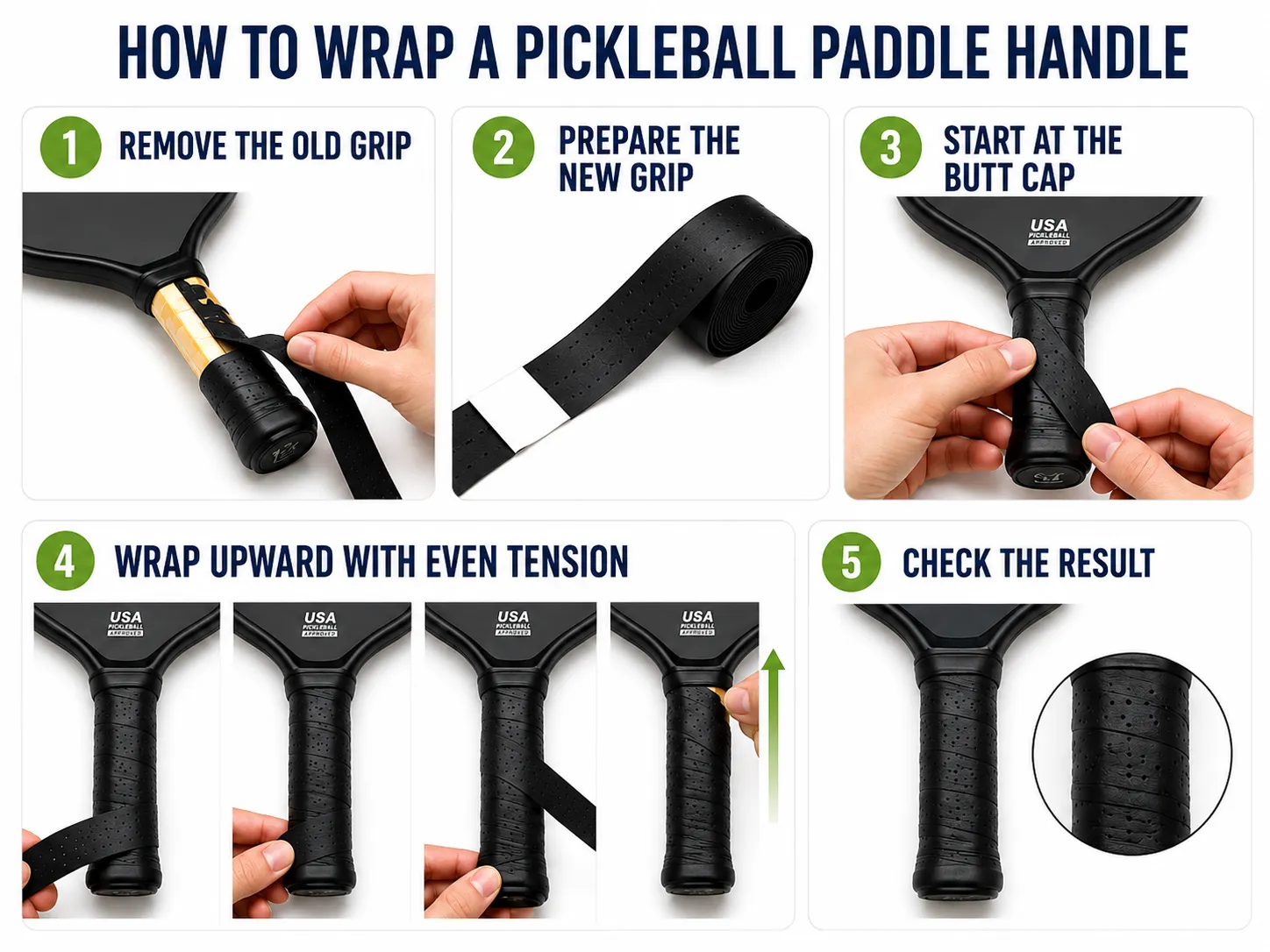
Here’s the full regrip process:
Step 1: Remove the old grip
Peel away the finishing tape at the top of the handle, then unwind the old grip material. If it tears, keep pulling. Scrape away leftover adhesive and wipe the bare handle with rubbing alcohol on a cloth. Let it dry completely.
Step 2: Prepare the new grip
Unroll it and peel the plastic backing from the adhesive side. Locate the tapered end; that’s your starting point.
Step 3: Start at the butt cap
Professionals recommend placing the tapered end at the butt cap, slightly overlapping the lip, and angling the first wrap so it forms a snug collar without wrinkling.
Step 4: Wrap upward with even tension
Turn the paddle while guiding the grip upward. Overlap each turn by about one eighth to one quarter of an inch. Keep tension consistent; don’t stretch the material thin.
Step 5: Check the result
Run your hand over the grip. It should feel even with no ridges, bumps, or wrinkles.
What Does Weighted Tape Do to Pickleball Paddles?
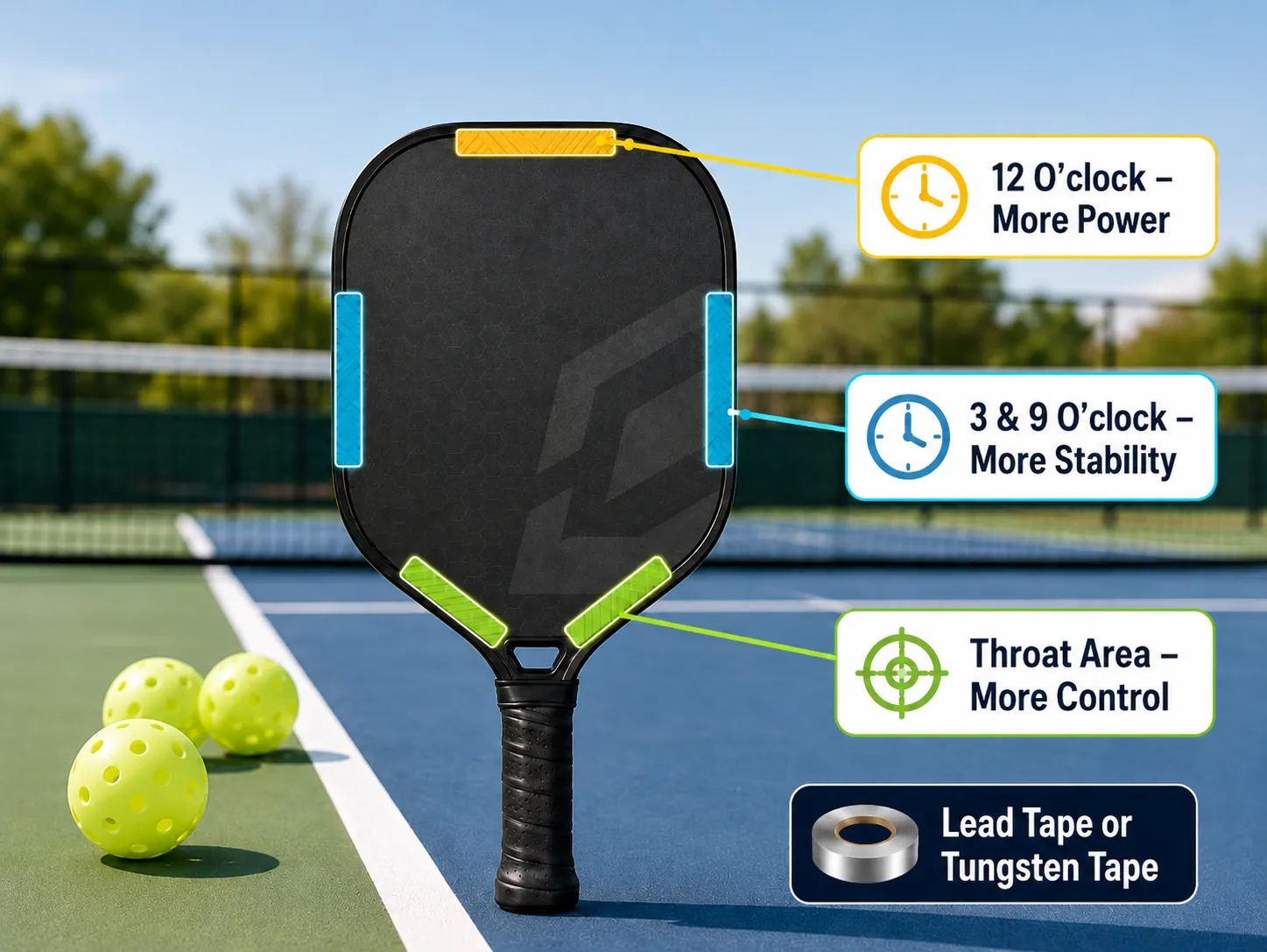
Adding weight to a paddle changes its balance, power, stability, and sweet spot size. The effects vary by where you place the tape:
- Top of the paddle (12 o’clock): Increases swing weight and power. The trade-off is reduced hand speed, so it suits aggressive baseliners more than finesse players in the
- Sides (3 and 9 o’clock): Adds stability on off-center hits and expands the sweet spot without dramatically slowing swing speed. This is often where beginners should start.
- Bottom corners (throat area): Improves stability and control, increases sweet spot size, and has the least impact on swing speed. Useful for players dealing with arm or elbow fatigue.
Where to Put Lead Tape on a Pickleball Paddle
Start at the sides or bottom corners to see how added weight affects your game before committing to heavier top placement. Most experienced players add between 0.2 and 0.8 ounces per side. Weigh the paddle before and after with a digital scale to track exactly what you’ve added.
Where to Put Tungsten Tape on a Pickleball Paddle
The placement logic for tungsten tape is identical to lead tape; the distinction is the material. Because tungsten is denser by volume, you can achieve the same weight addition with shorter strips. This makes it particularly useful on edgeless paddles or anywhere you want less visual bulk. Clean the paddle surface before applying, press firmly across the full length of the strip, and cover with a thin layer of clear edge guard tape if it’s applied along the side edge.
Do Pickleball Paddles Wear Out?
Yes. Even high-quality pickleball paddles eventually lose performance because of repeated impact.
The main signs of paddle wear include:
Surface Wear
The paddle face texture gradually becomes smoother, reducing spin performance.
Core Compression
Repeated hits can compress the internal honeycomb core, causing reduced power and inconsistent shots.
Delamination
Delamination happens when the paddle surface separates from the core.
Common signs include:
- Unusual sounds
- Dead spots
- Inconsistent ball response
- Visible bubbles or separation
How Long Do Pickleball Paddles Last?
The lifespan of a pickleball paddle depends on how often you play and how aggressively you use it.
Casual Players
Players who play once or twice per week can usually expect a quality paddle to last 1–3 years.
Regular Players
Players who practice several times per week may replace their paddle every 6–18 months.
Competitive Players
Tournament players may replace paddles more frequently to maintain consistent performance.
Proper cleaning and storage can help extend paddle life.
How to Clean a Pickleball Paddle
Tiny pieces of plastic dust from the ball settle into the surface texture after every hit. Cleaning a pickleball paddle restores spin and extends its life.
For the paddle face: The best tool for carbon fiber surfaces is a paddle eraser, a non-abrasive rubber block that lifts ball residue out of the surface texture. For fiberglass or graphite surfaces, a slightly damp lint-free microfiber cloth works well; a carbon eraser can damage non-carbon surfaces, so check your paddle’s face material first. Wipe in circular motions with light pressure.
What not to use: Never submerge the paddle in water. The core inside isn’t waterproof; moisture that gets through the edge guard or seams can damage it from the inside. Avoid bleach, ammonia, acetone, alcohol-based cleaners, and abrasive scrub pads.
The grip: Wipe the handle down after every session with a dry cloth. Sweat and oils build up quickly and accelerate grip wear.
Where Can I Buy Pickleball Paddles?
Pickleball paddles are widely available, but where you buy matters if you want to test before committing.
Brand websites: Buying direct gives you access to the full product line, warranty registration, and in some cases pre-order access to new models.
Amazon and online marketplaces: Wide selection and fast shipping. Read verified buyer reviews carefully and check that you’re buying from the official brand or an authorised reseller to avoid counterfeit paddles, which have become a problem in the category.
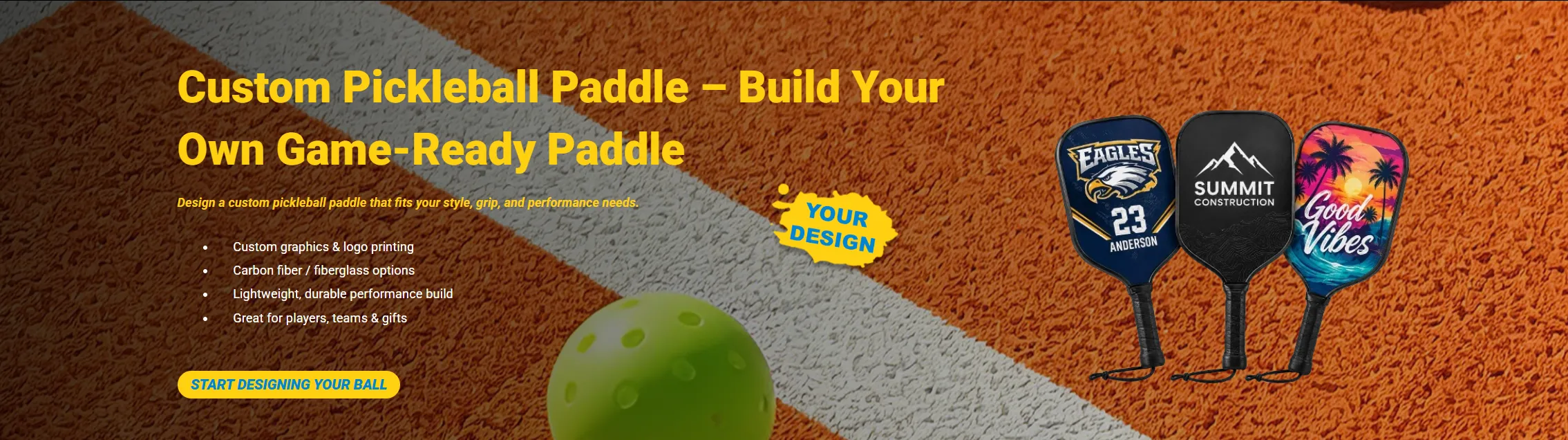
Custom paddles: If you’re equipping a team, club, or event, custom-branded paddles are available from Fastcustomjerseys who print logos directly on the surface.
Conclusion
Paddle tennis and pickleball look similar at a glance, but the court dimensions, ball, scoring, and equipment make them genuinely different sports. For pickleball specifically, the paddle you choose and how you care for it shape your game more than most beginners realise.
A polymer core with a carbon fiber face handles most playing styles well. The continental grip gives you the most flexibility at the kitchen line. Lead or tungsten tape at the sides or bottom corners adds stability without sacrificing hand speed. Regrip every 50 to 100 hours of play. Clean the face regularly with a paddle eraser or damp cloth, never harsh chemicals. Fastcustomjerseys is the best site to get customized paddle tennis and pickleball for teams.